Short Course Offerings for October 6, 2026
Four short courses will be offered as part of the conference registration. Two short courses will be offered concurrently in the morning and in the afternoon.
Morning Short Course Options, 8am to Noon
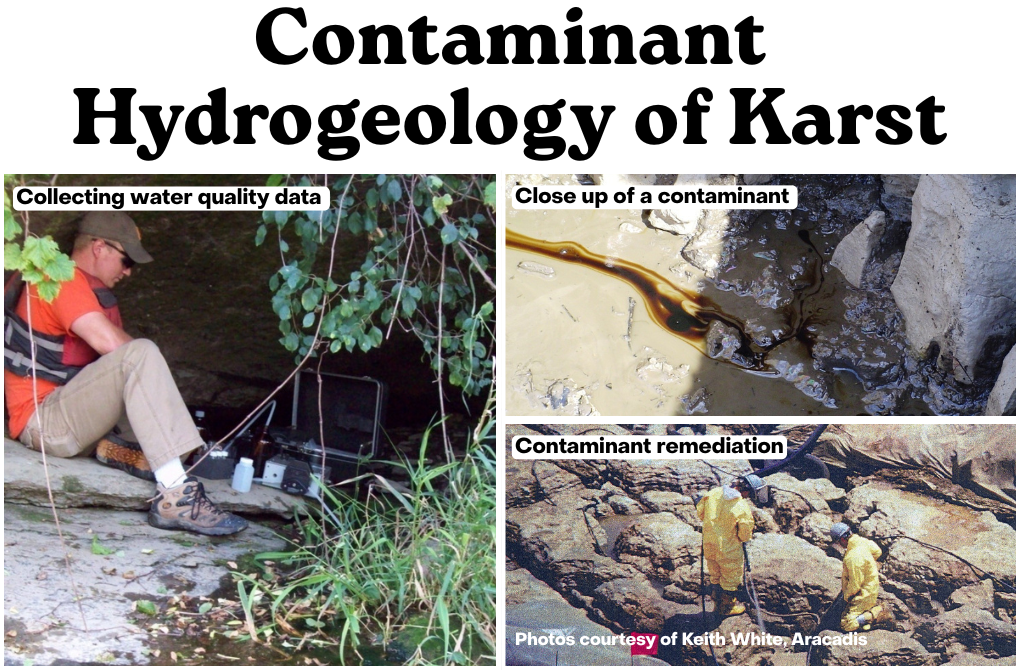
Contaminant Hydrogeology of Karst
Instructed by:
Keith White, (Arcadis U.S.)
Summary
Karst terranes provide unique challenges to professionals faced with characterizing, managing, and remediating sites impacted by regulated substances. Groundwater flow and chemical transport in karst may be complicated by conduits that are difficult to locate, turbulent flow, extreme geologic heterogeneity, sediment transport, dual-porosity and dual-permeability regimes. Because of these complexities, widespread knowledge and understanding of contaminant hydrogeology of karst is limited. Furthermore, up to 25% of the world’s population depends on waters from karst aquifers.
This intermediate-level short course focuses on contaminant hydrogeology of karst and is intended for participants who already have a basic understanding of hydrogeology. The target audience is professionals faced with or interested in the subject. In addition, attendees will receive a comprehensive bibliography citing nearly 100 benchmark papers and other key sources of information relevant to karst hydrogeology.
4 Professional Development Hours (PDHs) are available upon completion.
Relevant Topics Include: Conceptual Models, Multiphase Flow, Fate and Transport of Dissolved Compounds, Metals, and Pathogens, Monitoring and Characterization Techniques, Remediation and Management, Role of Clastic Sediment in Contaminant Storage, Transport, and Attenuation
Course Attendees Will Gain a Working Knowledge of:
- Fundamentals of karst hydrogeology
- Characteristics of the primary contaminants to karst aquifers
- Major karst aquifer contamination sources, typical receptors, modes of storage and transport
- Current status of quantitative modeling of groundwater flow and contaminant transport in karst
- Approaches and strategies for characterizing, remediating, and managing contaminated sites in karst terranes
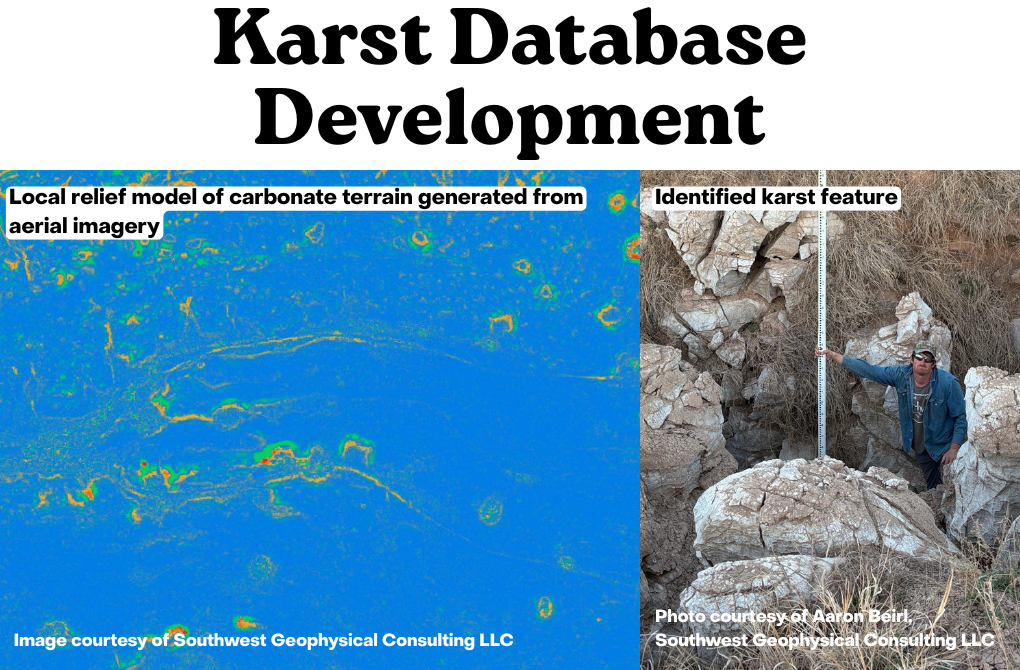
Karst Database Development: Techniques for Managing Large Volume Karst Data Sets
Instructed by:
Dave Decker, PhD, PG, CPG (Southwest Geophysical Consulting, LLC)
Dan Doctor, PhD (U.S. Geological Survey)
Summary
Collection of karst data in the field is very challenging and is often done by non-karst experts in an unstructured fashion. Assigning unique inventory control numbers to each feature and then associating feature type, size, applicable notes, and other significant attributes (including field photos) to these features when multiple field campaigns are occurring simultaneously can be challenging. This short course is designed to demonstrate a strategy that can facilitate the move toward standardization of the types of data collected in karst areas, how those data may be structured within a relational, GIS-focused database, and then easily associated with previous or future data sets for inclusion in current and follow on projects.
4 Professional Development Hours (PDHs) are available upon completion.
Course Attendees Will Gain a Working Knowledge of:
- The minimal information needed for a comprehensive karst feature inventory inclusive of sinkholes, springs, dye traces, and caves (where admissible)
- Assignment of basic attribute information to provide additional value to karst feature inventory
- How to associate these features in a GIS relational database format
- Some examples of karst feature datasets from different areas in the U.S.
Afternoon Short Course Options, 1-5pm
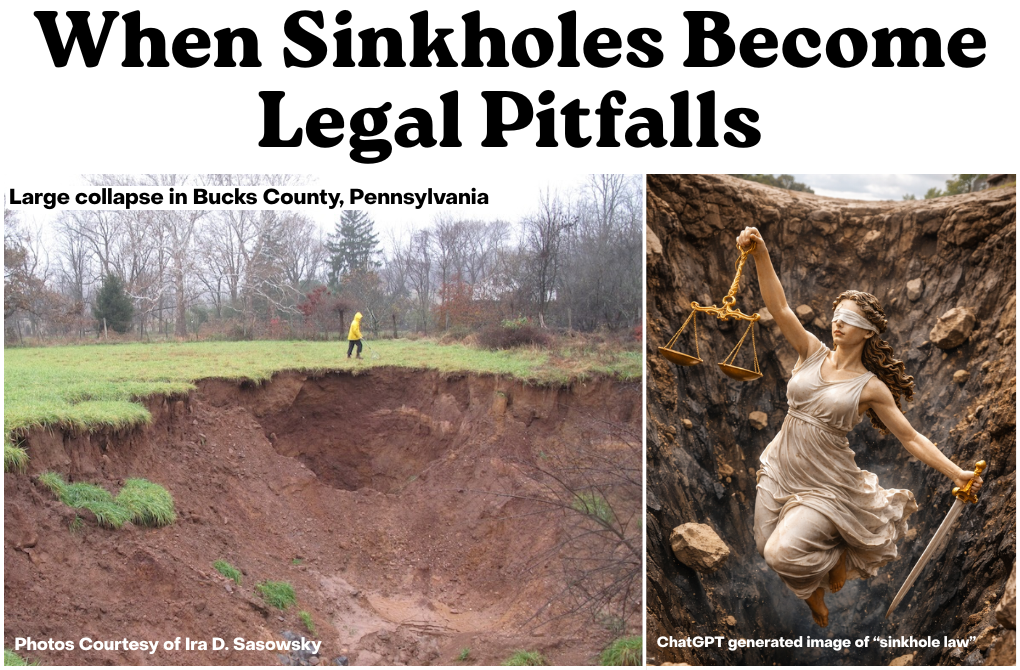
When Sinkholes Become Legal Pitfalls: "Sinkhole Law" and How to be an Indispensable Expert Witness
Instructed by:
Peter Keays, JD (Hangley, Aronchick, Segal, Pudlin, & Schiller)
Steve Miano, JD (Hangley, Aronchick, Segal, Pudlin, & Schiller)
Ira Sasowsky, PhD, PG (University of Akron)
Summary
It’s no mystery that sinkholes often create significant legal issues of various stripes, but the nature of those issues and how they are resolved is far less obvious. This course will demystify the legal dimensions of sinkholes in a way that is accessible to non-lawyers and provide a scientific and technical audience with practical guidance on how to be an effective advisor, consultant, or expert witness in the legal realm. The course is designed to be highly engaging, with case studies and audience participation throughout.
The first portion of the course will provide a primer on the types of legal issues that can be implicated when a sinkhole occurs. This will include an explanation of the various claims that can be brought by nearby property owners and other parties impacted by a sinkhole, the elements that must be proven for each claim, and the types of damages and other remedies that are available. We will also cover the various types of legal recourse available to regulators and nearby property owners when addressing or attempting to prevent sinkholes, including permit conditions and modifications, enforcement actions, settlement agreements, and (if all else fails) litigation. Throughout this portion, particular emphasis will be placed on the concept of causation, which is a critical but complicated component of most claims, and is an area in which effective expert work is essential.
The second portion of the course will cover the role and effective use of technical experts and impart practical guidance to successfully navigate the legal world. Topics will include: tips for working with lawyers; what makes a great expert; the importance of terminology; communicating complex technical topics to lay audiences—including judges— through effective expert reports, visuals, and testimony; how to prepare for and survive a deposition or cross-examination; addressing unfavorable facts and contrary opinions by experts “on the other side”; and avoiding common pitfalls throughout the process.
The course will conclude with a group exercise intended to immerse attendees in these concepts and give them the opportunity to put what they’ve just learned to use.
4 Professional Development Hours (PDHs) are available upon completion.
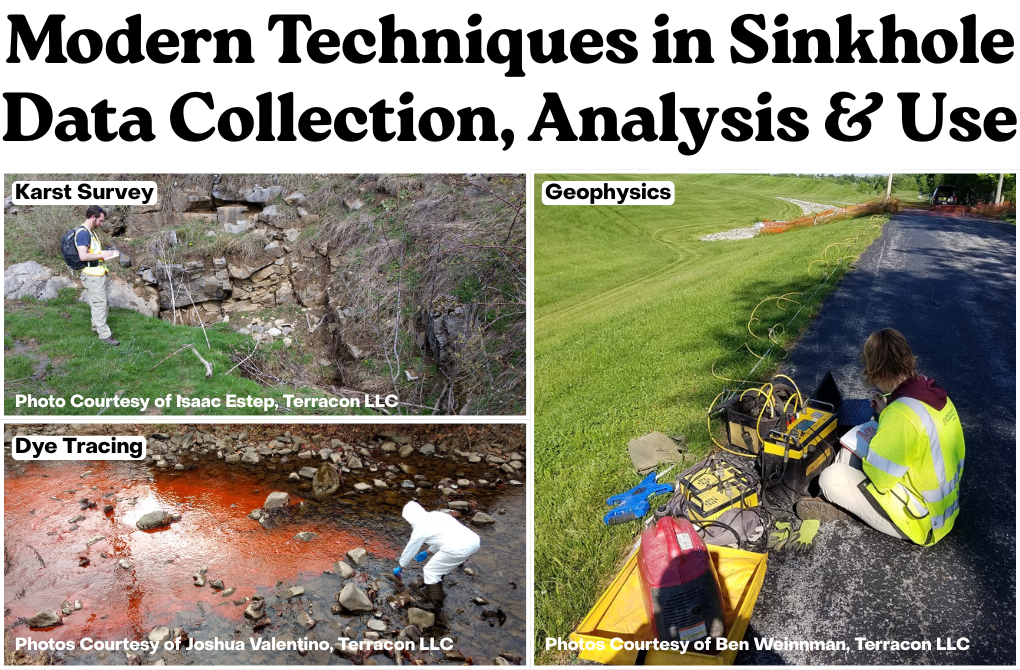
Modern Techniques in Sinkhole Data Collection, Analysis, and Use
Instructed by:
Michael Jones, M.S., PG (Southwest Geophysical Consulting, LLC)
Joshua Valentino, PhD, PG (Terracon Consultants)
Summary
Sinkhole investigations have evolved rapidly over the past decade due to advances in remote sensing, GIS, and data management. This half-day short course offers a practical, comprehensive overview of modern strategies for identifying, verifying, and applying sinkhole and karst feature data in environmental, engineering, and land-management contexts.
The course begins with a concise review of karst and sinkhole fundamentals, covering geologic settings that favor sinkhole formation and the range of surface karst features encountered in practice. Participants are then introduced to contemporary desktop reconnaissance techniques, including the use of aerial imagery, LiDAR-derived products, and existing datasets to identify and prioritize potential sinkholes before fieldwork begins.
Building on the desktop phase, the course covers field data collection and verification strategies, emphasizing efficient methods for confirming sinkholes, distinguishing karst from non-karst features, and documenting observations to support defensible decision-making. Advanced techniques, such as drone-based imagery and surface modeling, will be introduced, with discussion of their best-use scenarios and integration with traditional fieldwork.
The latter portion of the workshop focuses on data cataloging, GIS workflows, and long-term data management. Participants will learn how sinkhole datasets are structured, maintained, and translated into practical products such as maps, buffers, and constraint layers. Real-world examples will illustrate how these data support engineering design, environmental permitting,hazard assessment, and land-management decisions.
The format is interactive and discussion-based, emphasizing transferable techniques that attendees can apply to their own projects.
4 Professional Development Hours (PDHs) are available upon completion.